
Two soils, one outcome
Practically everything built here since the 1960s sits on a slab-on-grade foundation, and what that slab sits on changes as you cross the service area. Carrollton, Farmers Branch, Addison, Plano and Richardson stand on Blackland Prairie clay, which swells through a wet winter, then dries through a Texas summer and pulls away from the foundation. Lewisville, Flower Mound and Highland Village sit largely on the sandy loam of the Eastern Cross Timbers, and Coppell straddles the change.
The two grounds break pipes differently and arrive at the same place. Clay moves, and it moves unevenly, because the soil under one corner of a house rarely behaves like the soil under another. A slab rides that, and a line cast into the concrete moves with it until copper thins at a bend or an old galvanised joint gives up. Sand barely moves, but water escaping into it travels and carries fine material away, and fill that loses volume stops supporting the slab above it.
What it looks like from inside the house
A slab leak rarely announces itself the way a burst line in a wall does. The water has nowhere open to go, so it saturates the fill under the concrete first and only later works up through a crack or the slab edge. By the time anything is visible it has usually been running a while.
- A damp patch of carpet, tile or plank flooring with no fixture above it
- A section of floor that feels warm underfoot, which points at a hot supply line
- The water meter still turning with every fixture in the house closed
- A water bill that climbed with no change in how much the household uses
- The sound of water moving when nothing is switched on, most often noticed at night
- A musty smell in one room, or baseboard beginning to swell along its bottom edge
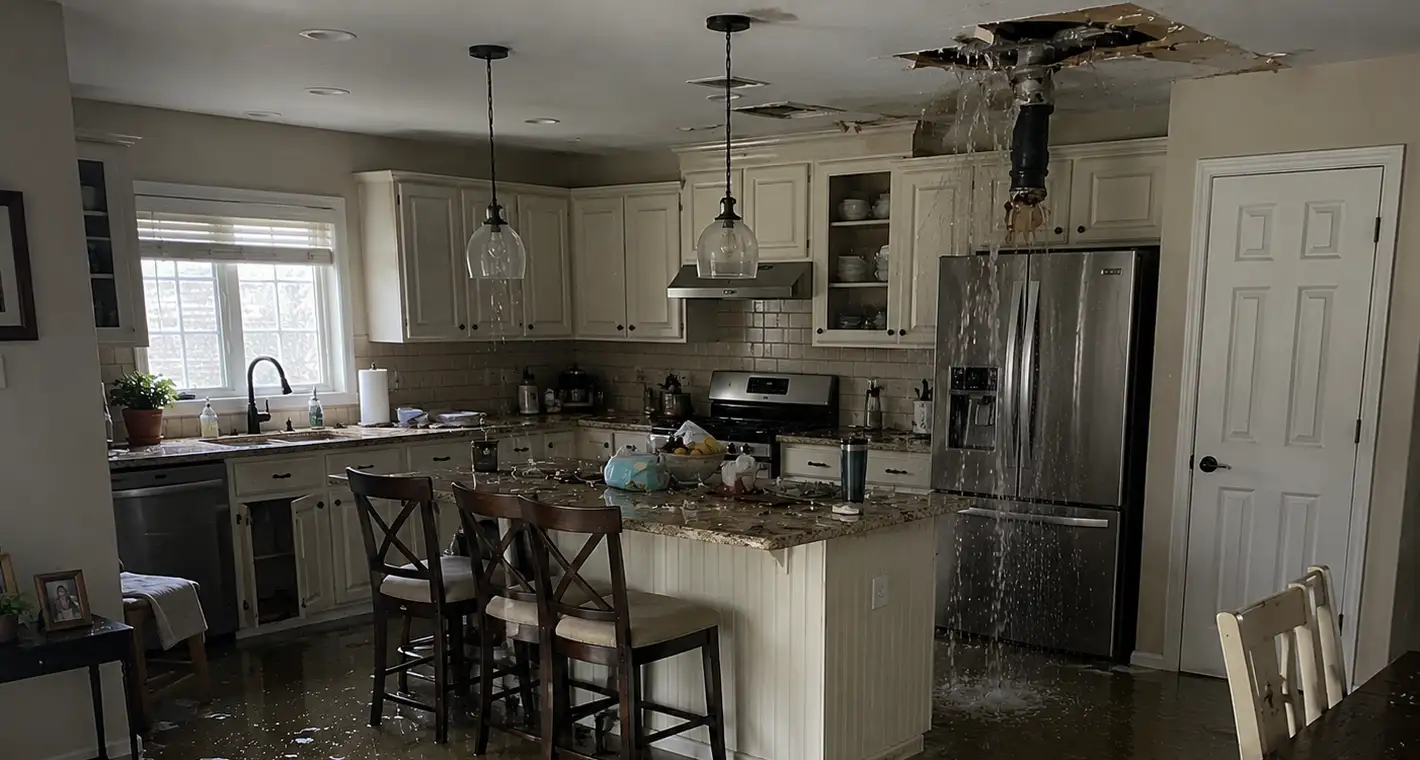
The last two mark the point where this stopped being only a plumbing problem. Once water has been under the floor long enough to reach a wall base, the job has changed from repairing a pipe into drying a structure and removing material that cannot be dried.
Locating it before anything is opened
The floor is not opened to hunt for the leak. It is opened once the leak has been found. The supply system is isolated first to confirm the loss is on a pressurised line rather than a drain, then hot and cold are tested separately. Acoustic equipment picks up water escaping under the concrete, and thermal imaging shows where a hot line is warming the slab.
Drain failures under a slab behave differently. They hold no pressure, so they lose water only while the fixture above is running, and they are found with a camera rather than by listening. On the older housing in Farmers Branch, Richardson and central Carrollton, where the line under the slab is cast iron, this is the more likely of the two.
Repair in place, or reroute through the attic
With the location known, the first option is to open the slab there: lift the flooring, break out the concrete, repair the pipe, patch the slab and reinstate the floor. That keeps the existing layout and makes sense where the system is otherwise sound.
The second is to leave the failed run in place and put a new line overhead, up a wall, across the attic and back down to the fixture. The slab is never opened. It suits North Texas houses, where the attic is already the mechanical space, and it is often chosen where the original piping is old enough that another failure along it is a fair expectation.
There is a further consideration on anything built from the 1980s onward. Most of it uses post-tension slabs, with steel cables running through the concrete under tension. They handle expansive clay well, and they cannot be cut wherever it is convenient: the slab has to be scanned to map the cables first. That step pushes many Plano, Coppell and Flower Mound repairs toward the overhead reroute. The decision belongs to the homeowner and the plumber, and both routes are worth knowing about before anyone starts cutting.
Drying the slab once the water is off
Stopping the leak does not dry the house. Concrete takes up water and gives it back slowly, and the fill under the slab can hold a great deal that keeps migrating upward after the pipe is fixed. Flooring over the affected area traps that moisture: glued vinyl and tile hold it against the concrete, and a floating plank floor lets water spread underneath while the surface stays convincingly dry.
Drying a slab loss therefore takes longer than the same volume of water in a house with a wood floor structure, and on the sandy west side the wet area is wider and its edges less distinct, because the water dispersed before it came up. Flooring is lifted over the wet area so air can reach the concrete. Wall bases are checked with a meter rather than by eye, since water crossing a slab enters at the tack strip and rises into the drywall from below. Readings are logged each visit against material that stayed dry, and equipment stays until the two agree. What is too wet to dry comes out: carpet padding, the bottom band of drywall, and cabinet toe kicks.
Slab leak water damage by city
- CarrolltonZIP 75006, 75007, 75010
- LewisvilleZIP 75057, 75067, 75077
- PlanoZIP 75023, 75024, 75025, 75074, 75075, 75093, 75094
- Flower MoundZIP 75022, 75028
- The ColonyZIP 75056
- CoppellZIP 75019
- Farmers BranchZIP 75234, 75244
- AddisonZIP 75001, 75254
- Highland VillageZIP 75077
- RichardsonZIP 75080, 75081, 75082
Frequently Asked Questions
- How do I tell a slab leak from something else?
- The pattern gives it away. Water shows at floor level with no fixture above it, usually as a damp area that keeps returning after it is mopped, and the floor may feel warm there if a hot line is involved. The meter keeps turning with every tap closed. A roof leak follows rain, and attic condensate marks a ceiling rather than a floor.
- Does the concrete have to be broken open?
- Not necessarily. Once the leak is located there are two routes: open the slab at that point and repair the pipe, or abandon the failed run and install a new line overhead. In North Texas the overhead route is straightforward, because every house here has an accessible attic to run it through and drop down inside the walls.
- Why do slab leaks turn up in fairly new houses here?
- Because the ground is doing the work rather than time alone. Blackland clay swells and shrinks through every wet and dry cycle, unevenly under a single slab. A copper line cast into concrete that flexes thins where it bends and at fittings. Twenty or thirty seasons of that is enough, which is why a 1990s house can develop one.
- Will homeowners insurance cover it?
- Policies commonly cover the sudden and accidental escape of water and the damage it causes, and many also cover access, meaning the concrete broken and replaced to reach the pipe. The failed pipe itself and gradual damage are frequently excluded. Because a slab leak often runs unseen, how long it leaked comes up, so report it promptly.