Water damage in Lewisville
Lewisville sits directly below the Lewisville Lake dam, where the Elm Fork of the Trinity leaves the reservoir and turns south. The Eastern Cross Timbers and the Blackland Prairie meet along this stretch, and the ground changes from sand to black clay across the width of the city. Old Town keeps early twentieth-century houses near Main Street. The bulk of the city is slab-on-grade tract building from the late 1970s through the 1990s, with newer construction in Castle Hills and along the lake side of town after 2000.
Water follows gravity and capillary action rather than room boundaries, so a failure in a Lewisville home routinely wets rooms nowhere near it.
Before help arrives
- Shut the water off at the fixture or the main if you can reach it safely.
- Keep out of any room where water has reached outlets, cords, or the electrical panel.
- Lift furniture off wet carpet and move what you can to a dry floor.
- Photograph the damage and the failure point before anything is moved.
- Do not use a household vacuum to pick up standing water.
Common causes in Lewisville
Sandy Cross Timbers ground on the west side
The western half of Lewisville sits on the sandy loam of the Eastern Cross Timbers rather than black clay. It drains fast, which sounds like an advantage and is not. Water from a broken line under a slab travels sideways instead of pooling, so a leak can surface a room away from the pipe that failed.
Low ground along the Elm Fork below the dam
Below the dam the Elm Fork runs through flat, low ground on the eastern edge of the city. The Corps of Engineers manages releases from Lewisville Lake, so the river rarely arrives without warning, but a controlled release through a wet week keeps the water table high under nearby yards, and street drainage that normally clears in minutes has nowhere to send it.
Polybutylene and early plastic supply lines
A great deal of Lewisville was plumbed between 1978 and 1995, the window when polybutylene and the first plastic fittings were standard. That material fails at the fitting, usually inside an attic or a wall, and it does not weep first as a warning. A house with no history of trouble is not evidence the pipe is sound.
Attic condensate through a July ceiling
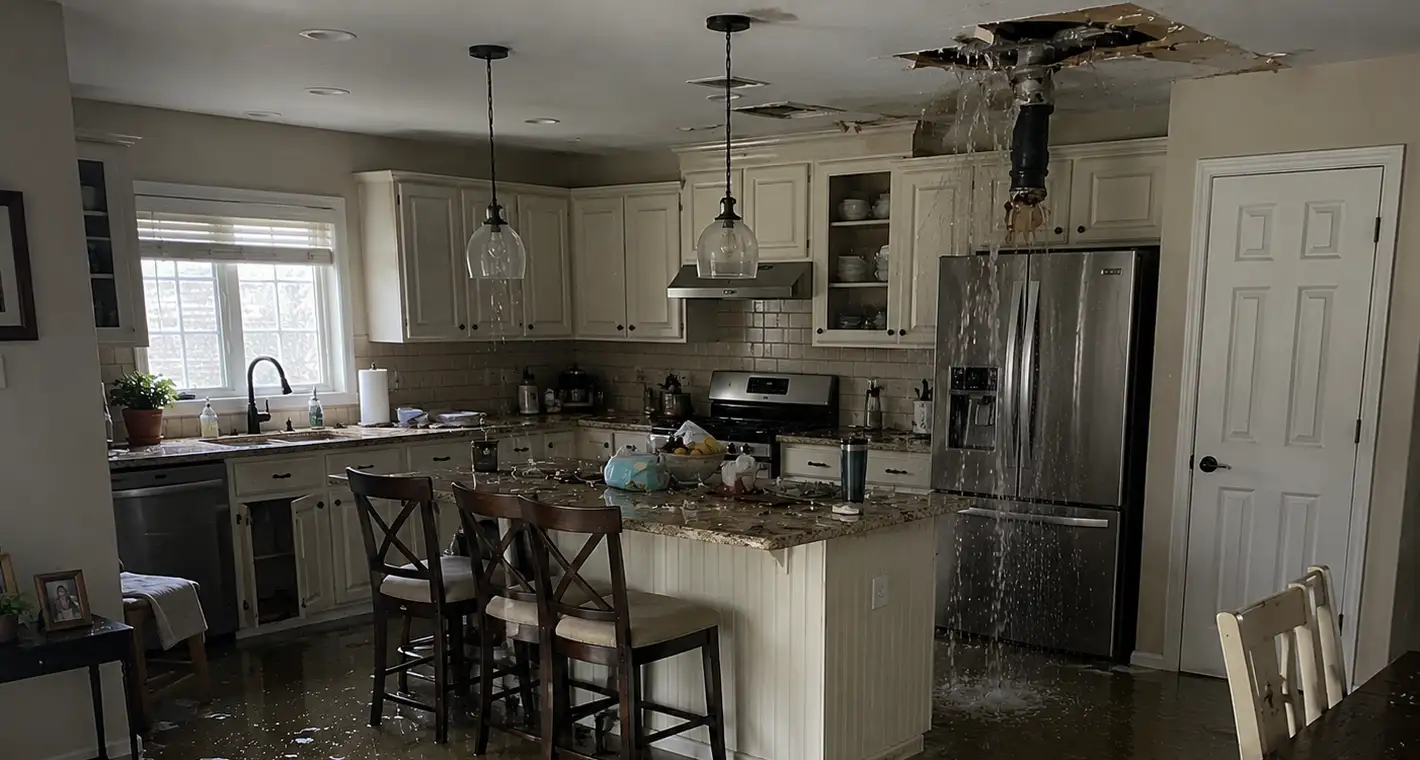
Summer humidity here runs high enough that an attic air handler pulls gallons of water out of the air every day. All of it leaves through one small line, and a clog fills the pan and spills over. It is the quietest loss in the city: the ceiling darkens slowly and nothing is obvious until the drywall sags.
Drying a Lewisville home
The soil under a Lewisville house decides how a slab loss behaves. On the sandy west side water leaves the break quickly and turns up at a distance from it; on the clay east side it stays close and sits. Either way the concrete holds it, and a meter reading at the wall base tells you considerably more than how the floor feels underfoot.
The sequence does not change from house to house: extraction first, then air movers and dehumidifiers together, with readings logged daily until materials reach the dry baseline. It is set out on the water extraction and drying page. Water arriving from beneath the floor is covered under slab leak damage, and anything left wet long enough to establish growth under mold remediation.
Services available in Lewisville
- Water Extraction & DryingStanding water removal and controlled structural drying under moisture readings.
- Slab Leak DamageWater surfacing through a slab-on-grade foundation, located and dried out.
- Sewage CleanupContaminated water handled with containment, removal and cleaning.
- Mold RemediationGrowth that established after water sat longer than it should have.
- Burst pipe and supply line cleanup
- Water heater and appliance leak cleanup
- Ceiling and drywall water damage
- Moisture inspection and mapping
Areas covered in Lewisville
Providers cover Lewisville and the surrounding area, including Old Town Lewisville, Castle Hills, Vista Ridge, Garden Ridge, Valley Parkway, College Street and Lake Park Road.
ZIP codes: 75057, 75067, 75077.
Frequently Asked Questions
- Will my homeowners insurance cover water damage?
- It depends on the cause rather than the damage. Policies commonly cover sudden and accidental events such as a burst supply line or a failed water heater. Gradual damage and surface flooding are usually excluded. Photograph everything before it is moved, keep any failed part, and report the loss promptly.
- Should I turn off the electricity?
- If water has reached outlets, cords, appliances, or the panel, treat the area as unsafe. Only shut off the breaker if you can reach it without standing in water. If you cannot, leave and have the utility or an electrician handle it.
- How do I tell whether my house sits on sand or on clay?
- The yard usually answers it. Black clay cracks open in August, wide enough to lose a garden stake in, and holds water on the surface after rain. Cross Timbers soil is lighter in colour, gritty in the hand, and takes rain straight down. Lewisville has both, split roughly west to east, and the two behave differently when a line under the slab fails.
- My house was built in 1988. Should I be concerned about the pipes?
- That sits inside the polybutylene window. It is worth finding out what you have: the pipe is grey or blue-grey plastic, about the diameter of a finger, and where it is visible it shows at the water heater or at the main shutoff. Knowing before it fails is the difference between a replacement you schedule and a ceiling you did not plan for.
- What is Castle Hills, and is it covered?
- Castle Hills is a master-planned area that became part of Lewisville, on the southeastern side of the city toward Josey Lane. It is newer housing than most of Lewisville, largely 2000s and later. It is covered like any other Lewisville address, and the failures there tend to run younger: appliance supply lines, water heaters and manifolds rather than deteriorated pipe.
- Water is coming up through the tile and no fixture is running. Why?
- That is the signature of a slab leak: a pressurised line under the concrete losing water with nothing above to explain it. On the sandy west side the water travels before it surfaces, so where it appears is not where the pipe broke. It is located acoustically before anything is opened.
- Does the Lewisville Lake dam put my house at risk?
- The dam is a flood control structure operated by the Corps of Engineers, built to hold water back rather than let it go suddenly. Its effect on houses below it is indirect. Through a wet stretch the Elm Fork runs high for days, the ground near it stays saturated, and drainage on the low eastern side clears slowly.