
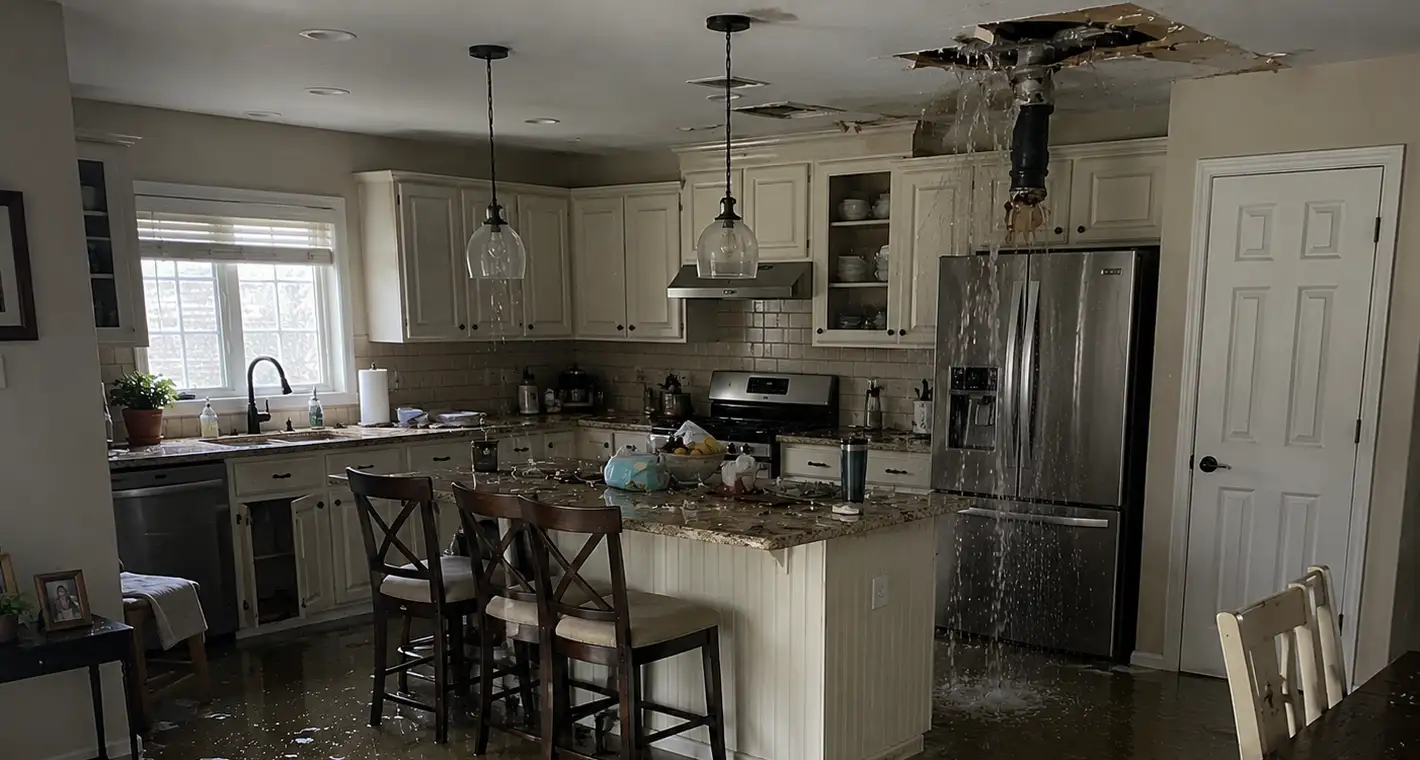
Water damage in Flower Mound
Flower Mound occupies the rolling ground between Grapevine Lake and Lewisville Lake, with Denton Creek running along the southern edge and the mound itself standing about 650 feet above the surrounding prairie. Almost everything is post-1980 slab-on-grade on larger lots, with heavy subdivision building through the 1990s and 2000s and continuing development along the Cross Timbers Road and Highway 407 corridors.
Water follows gravity and capillary action rather than room boundaries, so a failure in a Flower Mound home routinely wets rooms nowhere near it.
Before help arrives
- Shut the water off at the fixture or the main if you can reach it safely.
- Keep out of any room where water has reached outlets, cords, or the electrical panel.
- Lift furniture off wet carpet and move what you can to a dry floor.
- Photograph the damage and the failure point before anything is moved.
- Do not use a household vacuum to pick up standing water.
Common causes in Flower Mound
Lots that fall away toward the creeks and lakes
The ground here rolls rather than lying flat, and subdivisions were cut into it. Where a lot falls toward Denton Creek or toward one of the lake arms, storm runoff crosses the yard rather than sitting in it, and where a house sits below the driveway or below the street it takes that flow at the slab edge. Several inches against a slab is enough.
Irrigation systems on large landscaped lots
Larger lots here mean irrigation, and every system has a backflow assembly standing above grade near the house and a mainline running under the yard. The assembly is the part that splits in a freeze. A mainline break is quieter: it runs at street pressure into the soil beside the foundation and can go on for weeks before it shows up on a bill.
Pool equipment and backwash lines
Pools are common on these lots, and the equipment pad sits close to the house with pressurised plumbing running to and from it. A cracked filter housing, a failed pump seal or a backwash line that discharges toward the structure puts a steady volume of water into ground the foundation is bearing on, and it does so without ever appearing indoors.
Sand over clay at the Cross Timbers edge
Flower Mound sits where the sandy Eastern Cross Timbers soil thins over the clay beneath it, and the depth of that sand changes across the town. Water that escapes under a slab travels through the sand until it meets clay and then spreads out sideways along it. That is why the wet area indoors is often wider and shallower than the leak that caused it.
Drying a Flower Mound home
Houses here are large, which changes the arithmetic rather than the method. A loss that would be contained in a smaller floor plan spreads across more rooms before anything stops it, and the equipment count goes up accordingly. Rooms that were never wet still get monitored, because a house this size moves moist air a long way through its own ducts.
The sequence does not change from house to house: extraction first, then air movers and dehumidifiers together, with readings logged daily until materials reach the dry baseline. It is set out on the water extraction and drying page. Water arriving from beneath the floor is covered under slab leak damage, and anything left wet long enough to establish growth under mold remediation.
Services available in Flower Mound
- Water Extraction & DryingStanding water removal and controlled structural drying under moisture readings.
- Slab Leak DamageWater surfacing through a slab-on-grade foundation, located and dried out.
- Sewage CleanupContaminated water handled with containment, removal and cleaning.
- Mold RemediationGrowth that established after water sat longer than it should have.
- Burst pipe and supply line cleanup
- Water heater and appliance leak cleanup
- Ceiling and drywall water damage
- Moisture inspection and mapping
Areas covered in Flower Mound
Providers cover Flower Mound and the surrounding area, including Bridlewood, Wellington, The Highlands, Lakeside DFW, River Walk, Timber Creek and the Cross Timbers Road corridor.
ZIP codes: 75022, 75028.
Frequently Asked Questions
- Will my homeowners insurance cover water damage?
- It depends on the cause rather than the damage. Policies commonly cover sudden and accidental events such as a burst supply line or a failed water heater. Gradual damage and surface flooding are usually excluded. Photograph everything before it is moved, keep any failed part, and report the loss promptly.
- Should I turn off the electricity?
- If water has reached outlets, cords, appliances, or the panel, treat the area as unsafe. Only shut off the breaker if you can reach it without standing in water. If you cannot, leave and have the utility or an electrician handle it.
- Does the water in my yard after a storm matter to the house?
- It matters when it reaches the slab and stays. Runoff crossing a yard on its way downhill does little harm. Water standing against a foundation soaks the ground the slab bears on, and on a lot that falls toward the house it can reach the sill and the base of the wall directly, because slab construction here sits close to grade.
- Can pool equipment really damage the house?
- Indirectly, and it is common enough to be worth checking. The pad usually sits within a few feet of the structure, and a failed seal or split line puts a continuous volume of water into the soil beside the foundation. That changes how the ground under that corner behaves, and on the clay beneath the sand it does not drain away.
- How fast can someone reach a house on the west side of town?
- Flower Mound covers a lot of ground, and the west side toward Argyle and Highway 377 sits further from the main corridors than the Lewisville side. Under normal conditions the difference is small. After a regional freeze or a hail storm, when every provider in North Texas is working a backlog, it grows.
- The floor feels warm in one spot. What does that mean?
- A warm patch on a slab floor with nothing above it usually means the hot supply line under the concrete is losing water at that point. The concrete carries the heat before it carries the moisture, so the warmth often shows before any dampness does. It is worth acting on early, because the same leak is already wetting the fill under the slab.
- My water bill doubled and I cannot find a leak indoors. Where is it?
- On a Flower Mound lot the irrigation system is the first place to look. A mainline break under the yard runs continuously at street pressure, leaves no sign indoors, and on sandy soil may not even show at the surface. Shut the irrigation off at its own valve for a day and read the meter twice. If the loss stops, that is your answer.