
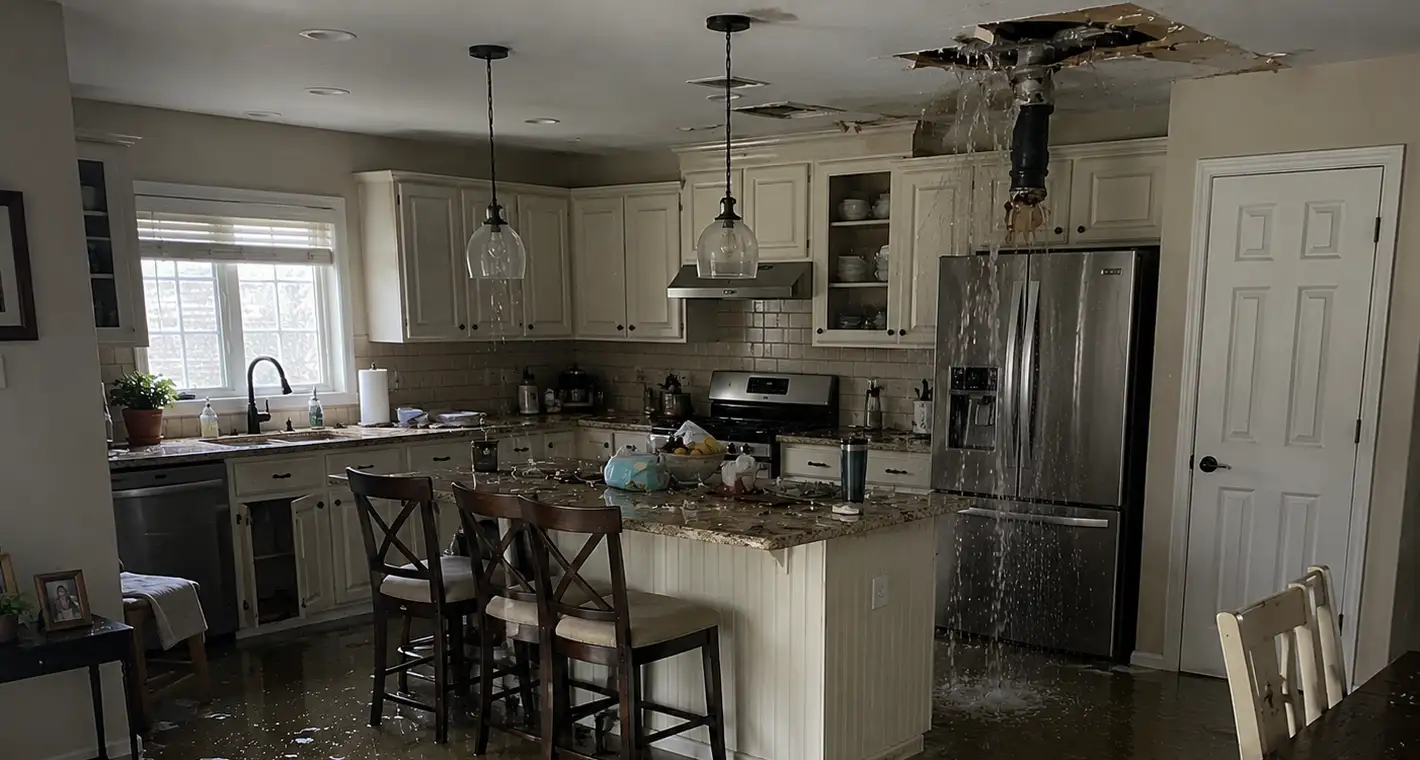
Water damage in Highland Village
Highland Village sits on wooded, rolling ground along the northeastern shore of Lewisville Lake, with Copperas Branch running down to the water and the Eastern Cross Timbers soil under most of the town. Building ran from the early 1980s through the 2000s on large wooded lots, almost entirely two-storey slab-on-grade houses, with the newest sections along Chinn Chapel Road and the older ones nearer the lake.
Water follows gravity and capillary action rather than room boundaries, so a failure in a Highland Village home routinely wets rooms nowhere near it.
Before help arrives
- Shut the water off at the fixture or the main if you can reach it safely.
- Keep out of any room where water has reached outlets, cords, or the electrical panel.
- Lift furniture off wet carpet and move what you can to a dry floor.
- Photograph the damage and the failure point before anything is moved.
- Do not use a household vacuum to pick up standing water.
Common causes in Highland Village
Lots that slope toward the lake
Subdivisions here were cut into ground that falls toward the shoreline, and a good number of houses sit below their own driveways or below the street above them. Storm runoff takes the shortest route down, and where that route crosses a slab edge or ends at a garage door, several inches of water arrive in the time it takes the rain to stop.
Sandy soil that drains and then settles
Cross Timbers sand takes rain straight down, which keeps yards firm and hides problems. Water escaping under a slab moves through it easily and can carry fine material with it, and the fill supporting one part of the foundation loses volume. The visible result is a slab settling in one area, well after the leak that started it stopped being obvious.
Heavy tree cover over the drain lines
The oaks that give the town its character sit directly over the sewer laterals running out to the street. Roots follow moisture through any crack in a line, and once inside they hold solids and slow the flow. The first symptom is a fixture draining more slowly than it did; the last is waste water on the floor of the bathroom nearest the slab.
Large houses left unattended
Houses on this scale often have rooms nobody enters for days at a stretch, and owners here travel. A supply line failing in a guest bathroom at the far end of an upper floor has time to work through the floor structure and the ceiling below before anyone walks past it. Size is what makes the difference, not the failure itself.
Drying a Highland Village home
Sandy ground under a Highland Village slab lets water disperse rather than pool, so the wet area indoors is broad and its edges are indistinct. Meters find a boundary that eyes do not. On sloping lots the same loss reads wetter at the downhill side of the house, and equipment is weighted toward that end rather than spread evenly.
The sequence does not change from house to house: extraction first, then air movers and dehumidifiers together, with readings logged daily until materials reach the dry baseline. It is set out on the water extraction and drying page. Water arriving from beneath the floor is covered under slab leak damage, and anything left wet long enough to establish growth under mold remediation.
Services available in Highland Village
- Water Extraction & DryingStanding water removal and controlled structural drying under moisture readings.
- Slab Leak DamageWater surfacing through a slab-on-grade foundation, located and dried out.
- Sewage CleanupContaminated water handled with containment, removal and cleaning.
- Mold RemediationGrowth that established after water sat longer than it should have.
- Burst pipe and supply line cleanup
- Water heater and appliance leak cleanup
- Ceiling and drywall water damage
- Moisture inspection and mapping
Areas covered in Highland Village
Providers cover Highland Village and the surrounding area, including Highland Shores, Briarhill, Doubletree Ranch, Copperas Branch, Chinn Chapel, the Village Parkway corridor and Lake Vista.
ZIP codes: 75077.
Frequently Asked Questions
- Will my homeowners insurance cover water damage?
- It depends on the cause rather than the damage. Policies commonly cover sudden and accidental events such as a burst supply line or a failed water heater. Gradual damage and surface flooding are usually excluded. Photograph everything before it is moved, keep any failed part, and report the loss promptly.
- Should I turn off the electricity?
- If water has reached outlets, cords, appliances, or the panel, treat the area as unsafe. Only shut off the breaker if you can reach it without standing in water. If you cannot, leave and have the utility or an electrician handle it.
- Does the lake level reach houses in Highland Village?
- For property outside the flood pool, no. What the lake does is hold the water table up on the shoreline side of town through a wet season, which keeps the ground under those slabs damp. It does not cause a loss, but it slows the drying of one: concrete on wet fill gives moisture back at its own pace whatever equipment is running.
- A drain is running slowly. Is that worth acting on?
- Yes, particularly on a wooded lot here. A single fixture draining slowly is usually local to that fixture. Several fixtures slowing at once, or the ones nearest the floor slowing first, points at the lateral out to the street. On these streets that generally means roots. Getting a camera down the line while it still drains is a great deal easier than after it stops.
- How does a two-storey house change the drying?
- It adds a floor assembly between the failure and the slab, and that assembly holds water. Subfloor, joist cavity and the ceiling below all take moisture and release it at different rates, so readings are logged on both levels. Where insulation between the floors is wet it comes out, because insulation left in place keeps water against the framing no matter how much air is moving.
- The house has been empty for two weeks. What should I expect?
- Expect the assessment to cover growth as well as moisture. Mould needs wet material and about forty-eight hours, and two weeks is well past that, so the question shifts from what can be dried to what has to come out. It does not automatically mean a large job. It does mean the wet material is looked at rather than simply having air blown across it.
- My yard drains well. Does that mean water cannot damage the slab?
- Good surface drainage helps, and it is not the whole picture. Cross Timbers sand takes water down quickly, which means water from a broken line under the slab moves through it just as easily and washes fine material out of the fill. A well-draining yard does nothing to prevent that.