
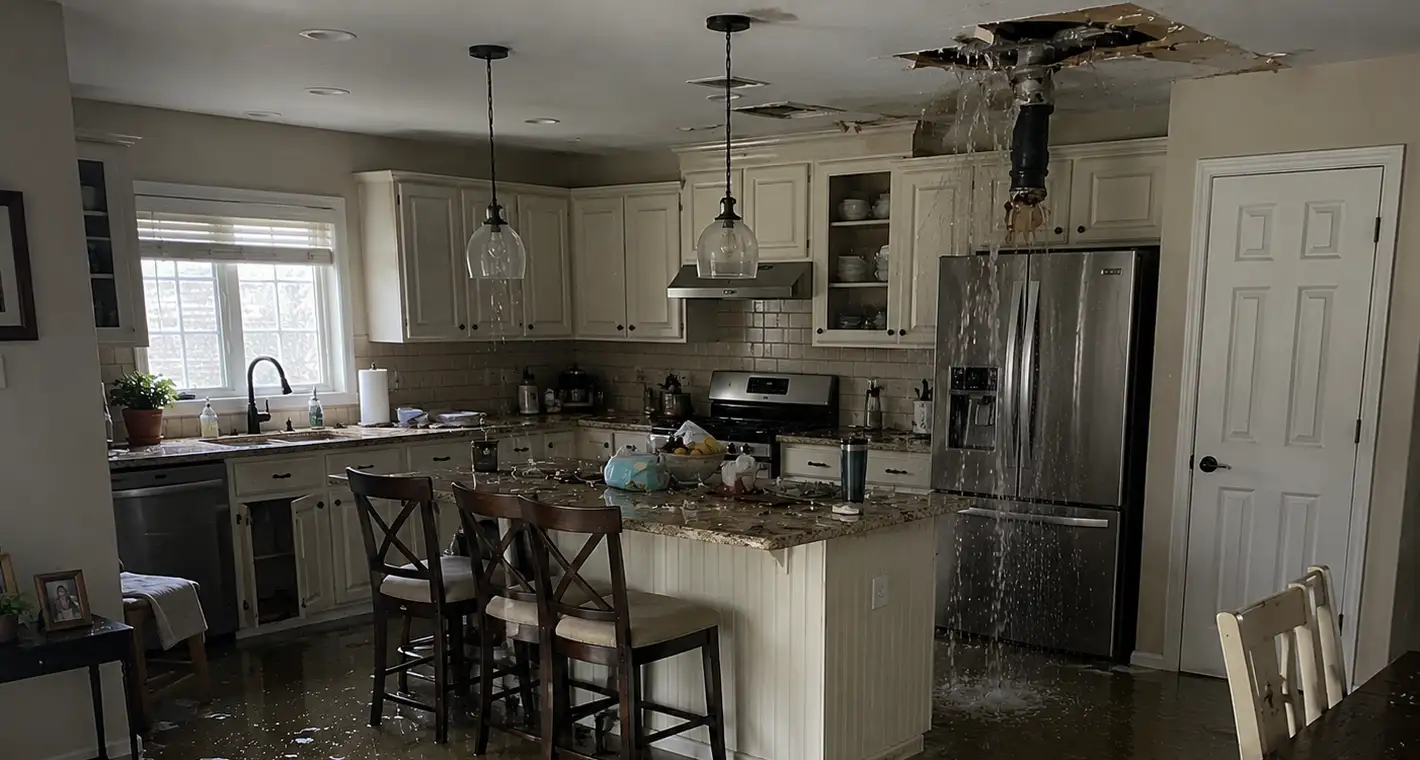
Water damage in Carrollton
Carrollton sits on the Elm Fork of the Trinity River, which forms the western city limit, and four named drainageways cross the city on their way to it: Dudley Branch, Furneaux Creek, Hutton Branch and Indian Creek. The old square dates to 1913 and keeps a small pocket of pre-war pier-and-beam houses. Everything else is slab-on-grade: heavy tract building from the 1970s through the 1990s, then newer subdivisions north of Hebron Parkway in Denton County.
Water follows gravity and capillary action rather than room boundaries, so a failure in a Carrollton home routinely wets rooms nowhere near it.
Before help arrives
- Shut the water off at the fixture or the main if you can reach it safely.
- Keep out of any room where water has reached outlets, cords, or the electrical panel.
- Lift furniture off wet carpet and move what you can to a dry floor.
- Photograph the damage and the failure point before anything is moved.
- Do not use a household vacuum to pick up standing water.
Common causes in Carrollton
Water heaters and air handlers in the attic
With no basement, the water heater and the indoor half of the air conditioner sit on a platform in the attic, directly above finished ceilings. A tank that lets go there does not spill onto concrete. It soaks insulation, comes through the drywall, and runs down inside the wall cavities to the slab. The drain pan underneath only helps while its line stays clear.
Cast iron drain lines under the older slabs
Houses built in Carrollton before the mid-1970s were plumbed with cast iron drain lines buried in or beneath the slab. Fifty years of Blackland clay moving under them opens joints and corrodes the pipe from within, and waste water then leaves the line under the floor. It surfaces as a damp patch near a bathroom wall with an odour that will not clear.
Hard freezes that arrive with the power off
North Texas plumbing is built for heat rather than cold: supply runs cross unheated attics and hose bibs sit on exterior walls. In February 2021 the region held below freezing for days while power went out in rotation, and the burst lines came as heat and pressure returned. Smaller freezes do the same one street at a time.
Flash runoff in the creeks that cross the city
Blackland clay takes in very little water, so a hard North Texas storm becomes runoff almost immediately. Furneaux Creek, Indian Creek, Hutton Branch and Dudley Branch fill and drop within the hour, and property backing onto the greenbelt or sitting low on a street sees water reach the slab edge. The Elm Fork itself is buffered by the reservoirs upstream. The small creeks are not.
Drying a Carrollton home
Two different losses show up in Carrollton and they dry differently. An attic failure wets the structure from above, so ceilings, insulation and the tops of walls come first. A slab loss spreads sideways under flooring until it reaches a wall base. Both end at the same concrete, which gives moisture back slowly for days after the surface reads dry.
The sequence does not change from house to house: extraction first, then air movers and dehumidifiers together, with readings logged daily until materials reach the dry baseline. It is set out on the water extraction and drying page. Water arriving from beneath the floor is covered under slab leak damage, and anything left wet long enough to establish growth under mold remediation.
Services available in Carrollton
- Water Extraction & DryingStanding water removal and controlled structural drying under moisture readings.
- Slab Leak DamageWater surfacing through a slab-on-grade foundation, located and dried out.
- Sewage CleanupContaminated water handled with containment, removal and cleaning.
- Mold RemediationGrowth that established after water sat longer than it should have.
- Burst pipe and supply line cleanup
- Water heater and appliance leak cleanup
- Ceiling and drywall water damage
- Moisture inspection and mapping
Areas covered in Carrollton
Providers cover Carrollton and the surrounding area, including Downtown Carrollton, Josey Ranch, Rosemeade, Indian Creek, Trinity Mills, Furneaux Creek and the Hebron Parkway corridor.
ZIP codes: 75006, 75007, 75010.
Frequently Asked Questions
- Will my homeowners insurance cover water damage?
- It depends on the cause rather than the damage. Policies commonly cover sudden and accidental events such as a burst supply line or a failed water heater. Gradual damage and surface flooding are usually excluded. Photograph everything before it is moved, keep any failed part, and report the loss promptly.
- Should I turn off the electricity?
- If water has reached outlets, cords, appliances, or the panel, treat the area as unsafe. Only shut off the breaker if you can reach it without standing in water. If you cannot, leave and have the utility or an electrician handle it.
- Do the creeks in Carrollton flood houses, or only the greenbelt?
- Most of the time the greenbelt takes it, which is what it was built for. The losses that reach houses come from short, intense storms where a creek leaves its bank for under an hour, or where street drainage backs up against a slab edge sitting inches above grade. Property along Furneaux Creek, Indian Creek and Hutton Branch sees it most.
- My address is in the 75010 ZIP code. Is that still Carrollton?
- Yes. Carrollton crosses three county lines, and 75010 covers the part of the city inside Denton County, north of Hebron Parkway. It is newer building than the rest of the city, mostly from the late 1990s onward, on ground that starts trading heavy black clay for the sandier soil of the Cross Timbers. Providers cover all three Carrollton ZIP codes.
- Why does my ceiling stain in summer when nothing has leaked?
- That is usually condensate. The attic air conditioner pulls a great deal of water out of North Texas air in July, and it leaves through one small drain line. When that line clogs, water backs into the pan and over the edge, and the first sign is a ring on the ceiling below, by which time it has run for weeks.
- How long does a Carrollton house take to dry out?
- A contained clean-water loss caught the same day is commonly three to five days on equipment. Anything that reached the slab and sat runs longer, because concrete releases moisture slowly and the fill beneath holds more. Daily meter readings against dry material elsewhere in the house set the schedule, not a number agreed in advance.
- The floor near my bathroom wall is damp and smells. What is that?
- On a pre-1975 Carrollton slab that points at the drain line rather than a supply pipe. Cast iron under the floor fails at the joints and along the bottom of the pipe, so waste water leaves under the slab and works up through a crack. A camera in the line confirms it, and what it soaked is handled as contaminated rather than dried.