
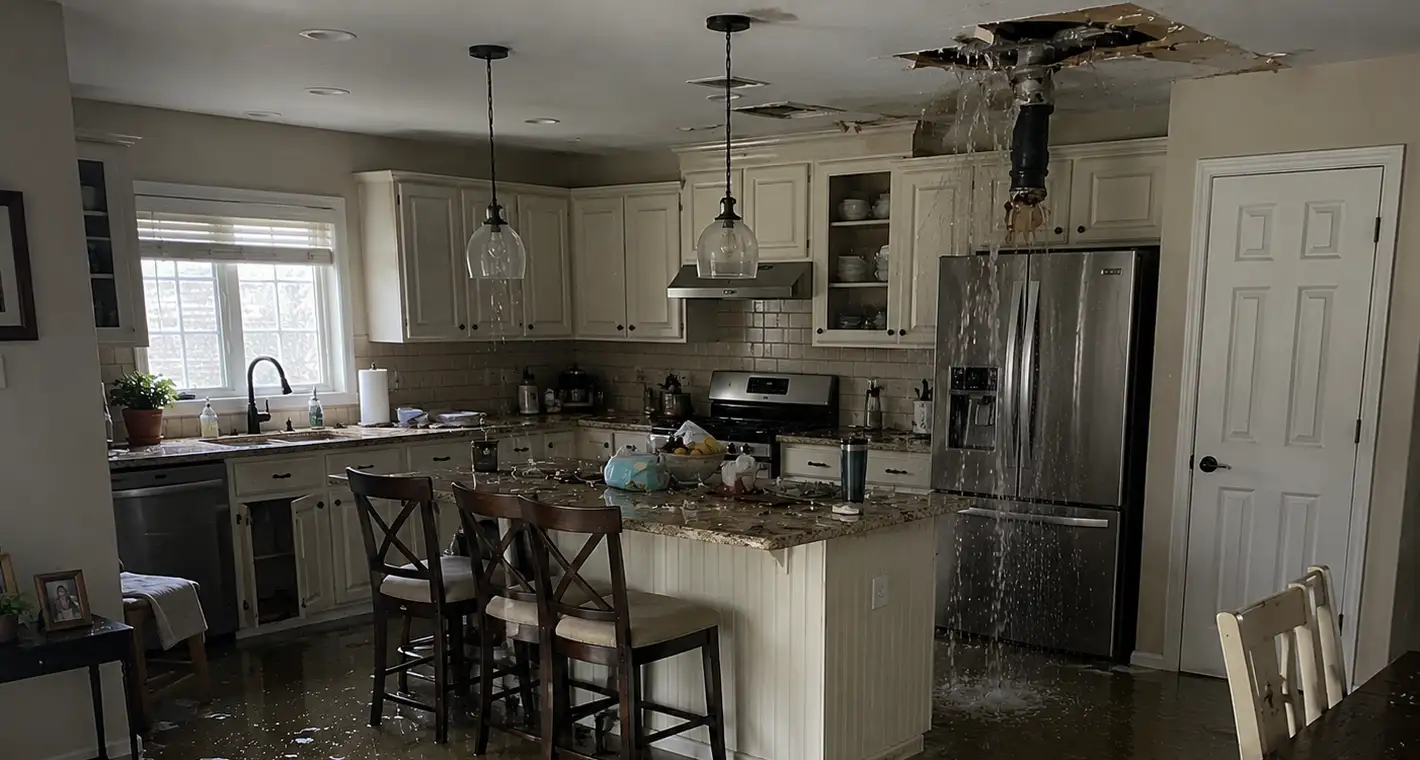
Water damage in Richardson
Richardson sits east of Addison on flat Blackland Prairie ground, drained by Duck Creek, Cottonwood Creek and the upper reaches of White Rock Creek, all of which run south through the older parts of the city. Richardson Heights and the neighbourhoods around it went up in the 1950s as single-storey slab ranch houses. Canyon Creek and the eastern sections followed through the 1960s and 1970s, with newer building out toward the Collin County line.
Water follows gravity and capillary action rather than room boundaries, so a failure in a Richardson home routinely wets rooms nowhere near it.
Before help arrives
- Shut the water off at the fixture or the main if you can reach it safely.
- Keep out of any room where water has reached outlets, cords, or the electrical panel.
- Lift furniture off wet carpet and move what you can to a dry floor.
- Photograph the damage and the failure point before anything is moved.
- Do not use a household vacuum to pick up standing water.
Common causes in Richardson
Galvanised and early copper supply lines
Houses from the 1950s were plumbed with galvanised steel, which corrodes from the inside until a threaded joint gives way, and the 1960s and 1970s stock used copper thin enough to develop pinholes. Both are decades past the point where failure is a surprise, and both usually fail inside a wall or under the slab.
Duck Creek and Cottonwood Creek flash flooding
Both creeks were channelled through neighbourhoods laid out before detention basins were required, and both carry water off a large area of pavement. A storm that drops two inches in an hour puts them out of bank briefly, and the houses backing onto them take water at the slab edge. The creeks drop again quickly, which is why the damage is often found after the fact.
Slab movement in the oldest clay neighbourhoods
The 1950s slabs here were poured before post-tension construction and to lighter standards than anything built today, and they sit on clay that swells and shrinks every year. Seventy cycles of that leave a foundation that no longer sits flat. The pipes cast into it and buried under it have taken the same movement, which is where the leaks come from.
Additions that put wet rooms over living space
A great many Richardson ranch houses have been extended upward or outward over the years, and second-floor bathrooms and laundries added to a house designed as single-storey sit over rooms that were never meant to be underneath one. Where the addition met the original structure is also where the floor assembly is least continuous, and water finds that seam.
Drying a Richardson home
Single-storey Richardson houses spread a loss across one level and into the slab beneath it, and much of the older stock has hardwood or tile bonded straight to the concrete. That covering traps moisture, so it is lifted over the wet area to let air reach the slab, and readings are taken in the concrete rather than off the floor surface.
The sequence does not change from house to house: extraction first, then air movers and dehumidifiers together, with readings logged daily until materials reach the dry baseline. It is set out on the water extraction and drying page. Water arriving from beneath the floor is covered under slab leak damage, and anything left wet long enough to establish growth under mold remediation.
Services available in Richardson
- Water Extraction & DryingStanding water removal and controlled structural drying under moisture readings.
- Slab Leak DamageWater surfacing through a slab-on-grade foundation, located and dried out.
- Sewage CleanupContaminated water handled with containment, removal and cleaning.
- Mold RemediationGrowth that established after water sat longer than it should have.
- Burst pipe and supply line cleanup
- Water heater and appliance leak cleanup
- Ceiling and drywall water damage
- Moisture inspection and mapping
Areas covered in Richardson
Providers cover Richardson and the surrounding area, including Richardson Heights, Canyon Creek, Cottonwood Heights, Prairie Creek, Duck Creek, the Arapaho Road corridor and Buckingham.
ZIP codes: 75080, 75081, 75082.
Frequently Asked Questions
- Will my homeowners insurance cover water damage?
- It depends on the cause rather than the damage. Policies commonly cover sudden and accidental events such as a burst supply line or a failed water heater. Gradual damage and surface flooding are usually excluded. Photograph everything before it is moved, keep any failed part, and report the loss promptly.
- Should I turn off the electricity?
- If water has reached outlets, cords, appliances, or the panel, treat the area as unsafe. Only shut off the breaker if you can reach it without standing in water. If you cannot, leave and have the utility or an electrician handle it.
- Do Duck Creek and Cottonwood Creek still flood?
- They still come out of bank in intense storms, though improvements have reduced how often. The houses affected back directly onto the channels or sit low where a street crosses them. It is brief: the creeks rise and fall inside an hour or two, and the problem is that water reached a slab edge and left before anyone saw it.
- My house is single-storey. Does that make drying simpler?
- It removes one variable and adds another. There is no floor assembly holding water between levels, which helps. But everything ends at the slab, and much of the older Richardson stock has flooring bonded directly to that concrete. Getting air to the slab means lifting the covering over the affected area, and the concrete then releases moisture over days rather than hours.
- Is a pinhole leak in copper worth fixing properly?
- A pinhole is a symptom of the pipe's condition rather than a one-off event. Copper develops them where flow and water chemistry have thinned the wall, and the rest of the run has been through the same decades. Patching the hole is legitimate as an immediate measure. Whether the run gets replaced is a separate conversation, and one worth having before the next one appears.
- We added a second floor. Does that change anything after a leak?
- It changes where to look. The junction between an addition and the original house is rarely a continuous assembly, and water in a floor structure finds that seam and follows it. Readings are taken where old and new meet, on both levels, because a stain far from the failure is normal in a house built in two stages.
- The water pressure has dropped and the water looks rusty. What is happening?
- In a 1950s Richardson house that combination usually means galvanised supply pipe near the end of its life. Corrosion builds up inside the pipe, which narrows the bore and reduces flow, and it sheds into the water. It is a warning rather than an emergency, and it is worth treating as one, because pipe in that condition fails at a joint with no further notice.