
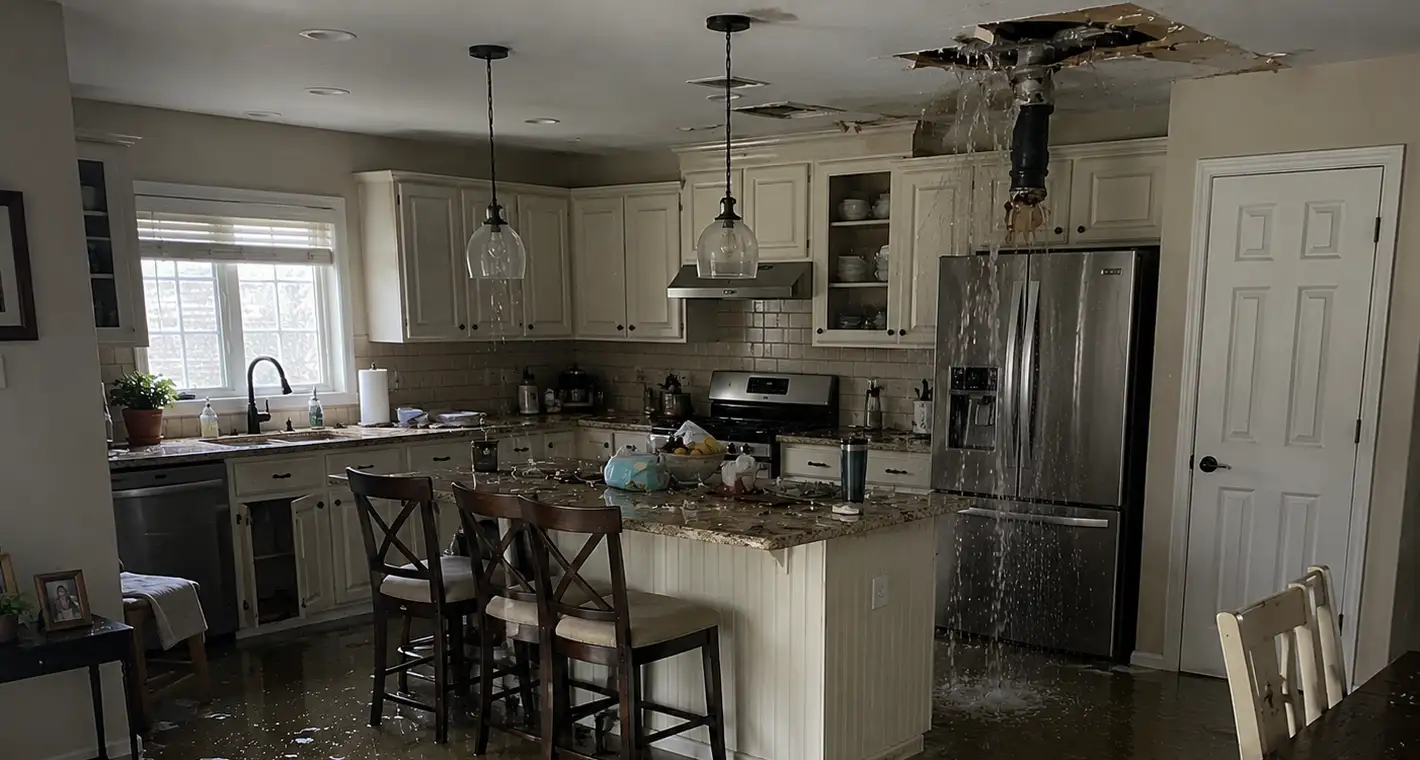
Water damage in Farmers Branch
Farmers Branch lies immediately south of Carrollton with the Elm Fork of the Trinity along its western side, and Rawhide Creek and Farmers Branch Creek crossing the city toward it through the older neighbourhoods. This is the oldest large housing stock in the service area. Most of the city was built between the late 1940s and the mid-1960s in single-storey slab-on-grade ranch houses, with redevelopment at Mercer Crossing and along the Interstate 35E frontage since 2010.
Water follows gravity and capillary action rather than room boundaries, so a failure in a Farmers Branch home routinely wets rooms nowhere near it.
Before help arrives
- Shut the water off at the fixture or the main if you can reach it safely.
- Keep out of any room where water has reached outlets, cords, or the electrical panel.
- Lift furniture off wet carpet and move what you can to a dry floor.
- Photograph the damage and the failure point before anything is moved.
- Do not use a household vacuum to pick up standing water.
Common causes in Farmers Branch
Cast iron and clay laterals under mid-century slabs
Houses of this era were plumbed with cast iron inside the slab and clay tile out to the main, both now sixty years in the ground and more. Cast iron corrodes from the invert until the bottom of the pipe is gone, and clay tile parts at the joints. What escapes is waste water, under the floor, with no crawl space to catch it.
Water heaters in interior closets
Ranch houses of the 1950s put the water heater in a hallway closet in the middle of the floor plan rather than in the attic or garage. That is an awkward position for a failure: the tank stands on the slab with finished, carpeted rooms on every side, and a slow seep works outward for days before anyone opens the door.
Sixty years of tree canopy on Blackland clay
The older streets here carry very large pecans and oaks planted with the houses. Through a dry summer those trees pull water out of the clay near the foundations, and the slab settles unevenly on the shaded side. The same roots follow moisture into cracked laterals, which is why root intrusion and slab movement turn up together.
Flash runoff in Rawhide and Farmers Branch Creeks
Both creeks run through ground developed before modern detention was required, and they rise and fall inside an hour during a hard storm. Property backing onto either one, or sitting low where a street crosses them, sees water at the slab edge. It leaves as fast as it came, so the loss is often found after the water has gone.
Drying a Farmers Branch home
Mid-century Farmers Branch houses are single-storey on a slab, so a loss stays on one level and spreads wide across it. Hardwood laid directly on the concrete in the older homes is the difficulty: it cups and lifts, and the slab underneath holds moisture long after the boards look settled. Readings are taken through the flooring rather than off its surface.
The sequence does not change from house to house: extraction first, then air movers and dehumidifiers together, with readings logged daily until materials reach the dry baseline. It is set out on the water extraction and drying page. Water arriving from beneath the floor is covered under slab leak damage, and anything left wet long enough to establish growth under mold remediation.
Services available in Farmers Branch
- Water Extraction & DryingStanding water removal and controlled structural drying under moisture readings.
- Slab Leak DamageWater surfacing through a slab-on-grade foundation, located and dried out.
- Sewage CleanupContaminated water handled with containment, removal and cleaning.
- Mold RemediationGrowth that established after water sat longer than it should have.
- Burst pipe and supply line cleanup
- Water heater and appliance leak cleanup
- Ceiling and drywall water damage
- Moisture inspection and mapping
Areas covered in Farmers Branch
Providers cover Farmers Branch and the surrounding area, including Brookhaven, Old Farmers Branch, Mercer Crossing, Valley View, the Josey Lane corridor, Rawhide Creek and Webb Chapel.
ZIP codes: 75234, 75244.
Frequently Asked Questions
- Will my homeowners insurance cover water damage?
- It depends on the cause rather than the damage. Policies commonly cover sudden and accidental events such as a burst supply line or a failed water heater. Gradual damage and surface flooding are usually excluded. Photograph everything before it is moved, keep any failed part, and report the loss promptly.
- Should I turn off the electricity?
- If water has reached outlets, cords, appliances, or the panel, treat the area as unsafe. Only shut off the breaker if you can reach it without standing in water. If you cannot, leave and have the utility or an electrician handle it.
- Water is seeping up around the hallway closet. What causes that?
- In a 1950s Farmers Branch ranch that is very often the water heater. It stands in that closet on the slab, and a tank near the end of its life seeps at the base rather than bursting. Water works out under the door into carpet on both sides, and the first sign is a damp edge along a hallway wall rather than anything in the closet.
- The hardwood floor has cupped. Can it be saved?
- Sometimes, and it depends on how long it was wet rather than how bad it looks now. Wood fixed to a slab takes up water from below and swells across the boards, which is what cupping is. If the slab dries before the boards delaminate, much of it flattens back out. That is decided after drying, not before.
- Do the big trees on my street cause foundation problems?
- They contribute to the movement rather than causing damage on their own. A mature pecan draws a great deal of water out of clay through a Texas summer, and it does so on one side of a house. That deepens the seasonal shrink there, the slab tilts further than it otherwise would, and a supply line in the concrete takes the strain.
- How is a sewage backup different from a clean water loss?
- It changes what can be kept. Clean water from a supply line lets most materials be dried in place. Waste water carries bacteria into everything porous it touches, so carpet, padding, the lower band of drywall and wet insulation come out rather than being dried. The area is contained first, and cleaning happens before drying starts.
- My house is from 1958. How long do the sewer lines last?
- Longer than anyone plans for, and not indefinitely. Cast iron inside a slab and clay tile out to the main both run about fifty to seventy years, and the older Farmers Branch stock is now at or past that. Failure is gradual: the pipe thins, joints open, roots get in, and backups grow more frequent before anything gives way.